
Lemongrass is one of those ingredients I associate immediately with Vietnamese cooking.
It’s fresh, citrusy and incredibly aromatic, but it doesn’t taste quite like lemon. It has its own herbal, slightly floral character that works particularly well with chicken, pork, seafood, chilli, garlic and fish sauce.
For a long time, I didn’t think too deeply about it. If I was making lemongrass chicken, I added lemongrass.
But there’s actually quite a difference between fresh lemongrass, frozen minced lemongrass and lemongrass paste, particularly when you’re deciding how much to use.
And there’s another practical reason this ingredient deserves its own Creacipes page:
I often use lemongrass paste.
Not because I think it’s necessarily better than fresh lemongrass. It’s because it’s convenient, consistent and something I can keep around for whenever I want it.
Creacipes is about how I actually cook, so if the recipe was made with paste, that’s what I’ll tell you.
If You Don’t Have the Lemongrass I Used
Fresh lemongrass and lemongrass paste aren’t perfectly interchangeable.
The strength of pastes can also vary considerably between brands, particularly when they contain oil, water, sugar, salt or other ingredients.
So I treat these as starting points rather than exact conversions.
| If my recipe uses | I’d try | What to expect |
|---|---|---|
| Lemongrass paste | Finely minced fresh lemongrass | Fresher, potentially more aromatic |
| Fresh lemongrass | Lemongrass paste | Convenient, but flavour can be slightly different |
| Frozen minced lemongrass | Fresh minced lemongrass | Usually a very useful substitute |
| Fresh stalks in soup | Frozen stalks or pieces | Works well when the lemongrass is being infused |
| No lemongrass | Lemon/lime zest in some dishes | Adds citrus aroma, but it won’t taste like lemongrass |
That last distinction is important.
Lemongrass isn’t lemon.
Adding lemon juice might give you acidity, but lemongrass itself isn’t primarily there to make food sour.
If I had to improvise, I’d be more inclined to experiment with a little lime or lemon zest for aroma rather than pouring lemon juice into a recipe and expecting the same result.
What Does Lemongrass Actually Taste Like?
Describing lemongrass as “lemony” is technically useful but doesn’t tell the whole story.
I find it:
citrusy + herbal + floral + fresh
without the sharp acidity you’d get from squeezing a lemon or lime.
That’s an important difference.
Lime juice can change the acidity of an entire marinade.
Lemongrass can make that marinade smell citrusy without doing the same thing to its acid balance.
That’s why you’ll sometimes find lemongrass and lime in the same recipe.
They’re doing different jobs.
Fresh Lemongrass
Fresh lemongrass is probably the version most people picture.
The stalk has tough green outer layers and a more tender, aromatic lower section.
For marinades and stir-fries, I’m mainly interested in the softer lower part.
I’ll remove particularly tough outer layers, trim it and mince the usable portion very finely.
And I mean very finely.
Large pieces of lemongrass can be fibrous and unpleasant to chew.
If I’m putting it directly into something I’m going to eat, I want it finely minced, pounded or processed.
Lemongrass in Soups Is Different
If I’m making something like a broth or soup, I don’t necessarily need to mince the lemongrass.
I can bruise a stalk and let it infuse the liquid.
That’s a completely different use.
The broth extracts the aromatic compounds while the tough stalk can be removed later.
So when a recipe tells you to:
bruise the lemongrass
rather than:
finely mince the lemongrass
there’s usually a reason.
One is being used almost like an aromatic tea bag.
The other is becoming part of the food.
Lemongrass Paste
This is the version you’ll see quite often in my recipes.
I’ve used supermarket lemongrass paste simply because it’s extremely convenient.
There’s no trimming.
There’s no finely chopping a fibrous stalk.
And there’s no discovering that the lemongrass I bought two weeks ago has become something I’d rather not put in dinner.
I squeeze or spoon out what I need and put the rest back in the fridge.
For everyday cooking, that’s valuable to me.
It works particularly well in things like:
marinades, grilled chicken, pork, sauces and meal prep.
But there is a trade-off.
Freshly cut lemongrass can have a brighter and more complex aroma.
And different commercial pastes aren’t necessarily equivalent.
That’s why if one of my recipes specifies lemongrass paste, I’ll increasingly try to tell you which one I actually used.
Is Fresh Lemongrass Better?
Sometimes.
But I don’t think that’s the most useful question.
A better question is:
Does fresh lemongrass make enough difference in this particular dish to justify the extra work?
If I’m making something where lemongrass is one of the dominant flavours, fresh lemongrass becomes much more interesting.
If I’m making a marinade containing:
fish sauce + soy sauce + honey + garlic + onion + pepper + lemongrass
the difference may be less dramatic.
That’s exactly the kind of thing I want to test.
There are plenty of occasions where I’ll happily spend more time for a better result.
There are others where I’d rather squeeze some paste from a tube and have dinner marinating in two minutes.
Both belong on Creacipes.
Lemongrass in Marinades
This is probably how I use lemongrass most often.
One of my favourite combinations is:
lemongrass + garlic + fish sauce
From there I can add ingredients such as soy sauce, honey, onion, chilli or black pepper depending on what I’m making.
Lemongrass gives the marinade a fresh aromatic character that works particularly well with fattier meats.
That’s one reason I like it with chicken Maryland or thigh fillets.
You get the richness of the dark meat against the freshness of the lemongrass.
It’s also excellent with pork.
Lemongrass and Fish Sauce
These two appear together constantly in my cooking.
And they’re doing very different things.
Lemongrass: aroma, freshness and citrus-herbal flavour.
Fish sauce: saltiness, fermentation and umami.
Then garlic adds pungency, and something sweet can help balance and brown the marinade.
It’s a relatively simple combination, but it explains a lot of Vietnamese marinades.
Once I started thinking about what each ingredient contributes rather than simply following a list, adjusting recipes became much easier.
Lemongrass and Honey
This is another combination you’ll see in some of my recipes.
Honey provides sweetness and helps the surface of meat caramelise under high heat.
Lemongrass provides aroma.
They’re complementary rather than substitutes for anything.
But honey isn’t mandatory.
Sugar can perform the sweetening role, and some marinades may not need much added sweetness at all.
As with everything else on Creacipes, I’d rather understand why it’s there than automatically add it.
Garlic and Lemongrass
I use these together so often that they’re almost a pair.
But it’s worth remembering that both can burn.
This matters particularly with the way I cook chicken in the air fryer.
Finely minced garlic, lemongrass and honey sitting on the surface of chicken can go from beautifully caramelised to burnt surprisingly quickly at 230°C.
That’s why I generally cook the meat through at a lower temperature first and use very high heat mainly for the finishing stage.
I’m looking for:
browning + blistering + slightly charred edges
rather than a layer of burnt aromatics.
Frozen Lemongrass
Frozen lemongrass is something I think deserves more attention.
If I have fresh lemongrass that I’m not going to use, freezing it makes much more sense than letting it deteriorate in the fridge.
You can also buy frozen minced lemongrass from many Asian grocers.
For cooked dishes and marinades, I find the convenience particularly appealing.
This is something I want to compare properly against both fresh lemongrass and paste.
If frozen minced lemongrass gives me almost all the flavour of fresh with most of the convenience of paste, that’s useful information.
Don’t Confuse Aroma with Acidity
This is probably the most useful thing I’ve learned about lemongrass.
When I taste something and think:
“This needs more freshness.”
there are several ways I could get there.
Lemongrass adds aromatic freshness.
Lime adds citrus aroma and acidity.
Vinegar adds acidity with its own flavour.
Those aren’t interchangeable adjustments.
Understanding that makes it much easier to fix a marinade or sauce without accidentally changing something else.
My Lemongrass Chicken
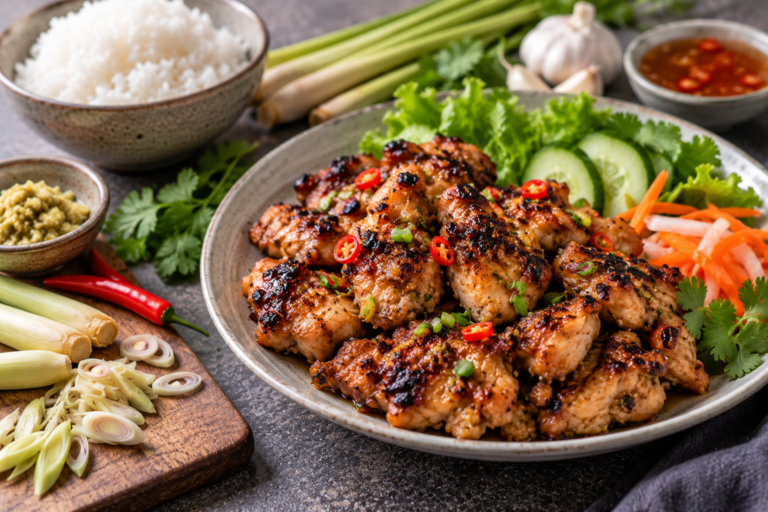
My Grilled Lemongrass Chicken is a good example of how I currently use the ingredient.
I combine lemongrass with fish sauce, light soy, garlic, honey and oil, then air fry the chicken and finish it at high temperature.
There’s nothing particularly complicated about it.
That’s exactly why I like it.
Lemongrass does a lot of the aromatic work while the other ingredients handle seasoning, umami, sweetness and browning.
It’s also a good recipe for experimenting.
I can make one batch with paste and another with fresh lemongrass and actually decide whether the difference matters to me.
What I Want to Explore
There’s still plenty I want to test:
- Fresh lemongrass versus paste
- Fresh versus frozen minced lemongrass
- Different brands of lemongrass paste
- How much paste actually equals one stalk in my cooking
- Whether pounding fresh lemongrass makes a noticeable difference
- Lemongrass in marinades versus broths
- How well fresh lemongrass freezes
- How much flavour survives long cooking
- Whether fresh lemongrass is noticeably better after air frying
- Which dishes are actually worth the extra preparation
I’m particularly interested in developing my own practical conversion between the paste I regularly buy and fresh lemongrass.
Not a conversion copied from somewhere else.
One I’ve actually tested.
An Ongoing Experiment
Like my guides to honey, vinegar, soy sauce, fish sauce and paprika, this page isn’t supposed to be the definitive guide to lemongrass.
It’s a record of how I’m learning to use it.
Sometimes I’ll use fresh lemongrass.
Sometimes frozen will make more sense.
And quite often I’ll reach for the paste because it’s Tuesday night and I want chicken marinating in the next five minutes.
I don’t think convenience automatically makes an ingredient inferior.
What matters to me is understanding what I’m giving up, what I’m gaining and whether I can actually taste the difference in the finished food.
That’s the point of these ingredient guides:
understand what the ingredient does, then decide how much the details matter for the food you’re actually cooking.
Cook with this ingredient
Try this ingredient in one of these recipes.


Questions or tips about this ingredient?