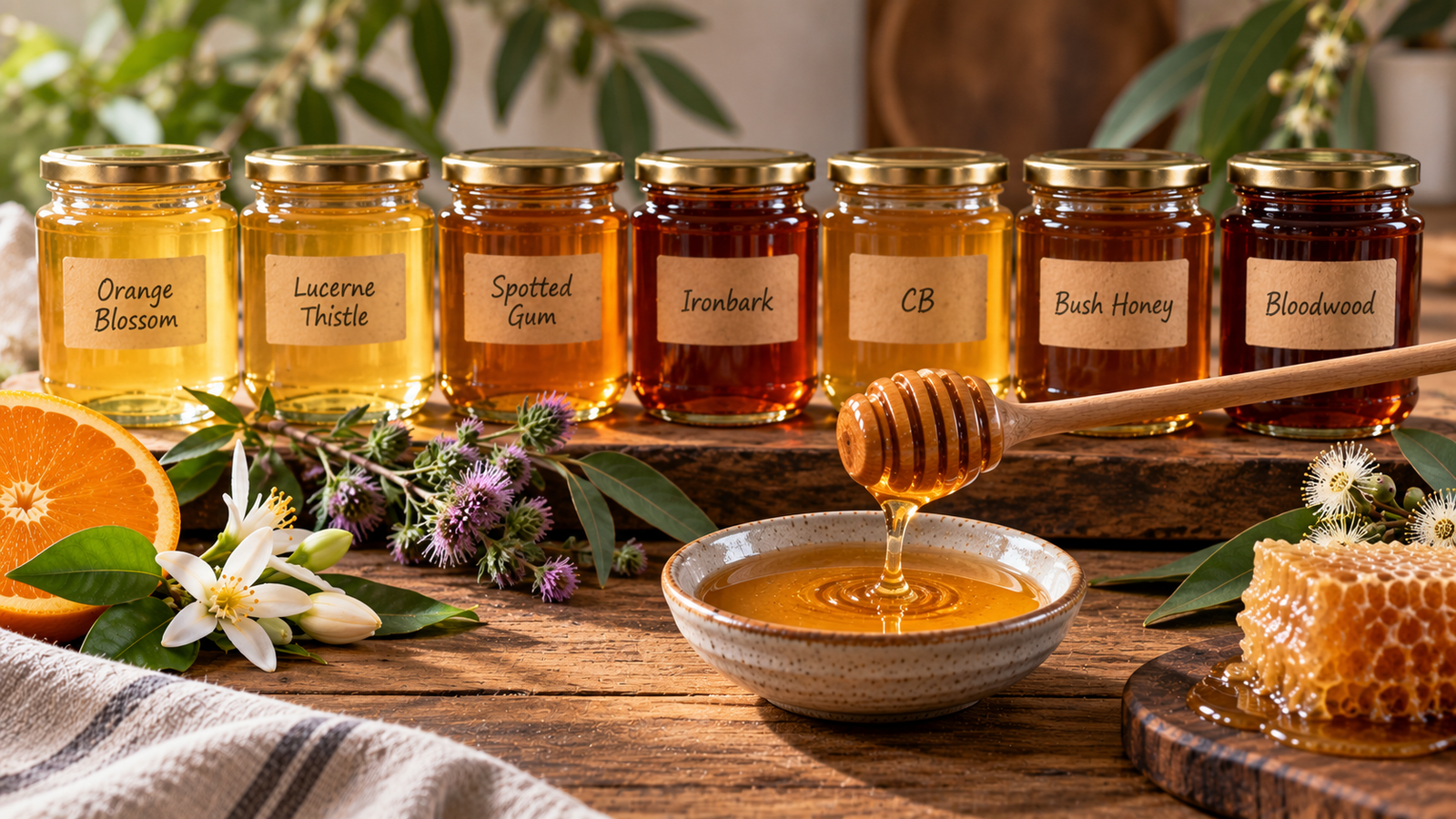
I use honey in a lot of my recipes.
I originally started using it because I preferred not to use processed white sugar where I could. But after trying different varieties of honey, I realised I could do more than simply replace sugar with something sweet.
Honey has flavour of its own.
Orange Blossom, Ironbark, Spotted Gum and Bloodwood can all bring something different to a dish. I’ve started choosing honey in much the same way I’d choose a vinegar, soy sauce or other seasoning, based on what I think will work with the flavours I’m cooking.
If you’ve arrived here from one of my recipes because you don’t have the honey I’ve used, don’t worry. You can substitute it.
Substituting Honey
You don’t need to buy a particular honey just to make one of my recipes.
The easiest option is to use another honey you already have. The flavour may be a little different, but for most of my sauces, marinades, dressings and pickles, that’s perfectly fine.
If you don’t want to use honey at all, sugar works too. Rather than replacing every honey with white sugar, I like to choose a sugar that roughly suits the character I was trying to get from the original honey.
| Intensity | Honey used in my recipe | Try another honey | Or try | Starting conversion |
|---|---|---|---|---|
| 1 – Delicate | Orange Blossom | Light floral honey | White or caster sugar | 1 tbsp → ~1½ tbsp |
| 2 – Mild | Lucerne Thistle | Mild floral honey | Raw or cane sugar | 1 tbsp → ~1½ tbsp |
| 3 – Medium | CB | Mild-medium honey | Raw or cane sugar | 1 tbsp → ~1½ tbsp |
| 4 – Medium | Bush Honey | Everyday bush honey | Raw sugar | 1 tbsp → ~1½ tbsp |
| 5 – Medium-rich | Spotted Gum | Medium Australian bush honey | Raw or dark cane sugar | 1 tbsp → ~1½ tbsp |
| 6 – Robust | Ironbark | Rich, robust honey | Light brown sugar | 1 tbsp → ~1½ tbsp |
| 7 – Robust | Bloodwood | Strong Australian honey | Brown sugar | 1 tbsp → ~1½ tbsp |
*I’m still experimenting with CB and will update this recommendation as I use it more.
These aren’t exact flavour replacements. Think of them as starting points based on the role I wanted the honey to play in the dish.
If you only have white sugar, use it. I would much rather you make the recipe with what you have than go shopping for one ingredient.
Quick Conversion
For the sauces, marinades, dressings and pickling liquids you’ll find throughout Creacipes, a simple starting point is:
1 tablespoon honey → approximately 1½ tablespoons sugar
Then taste it.
You might want more or less depending on the dish, the honey I originally used and your own preference. Honey also contains water while granulated sugar doesn’t, so this conversion shouldn’t automatically be applied to baking, where changing the liquid balance can affect the result.
Honey Isn’t Just Sweet
When I first started substituting honey for sugar, I mostly thought of it as another way of adding sweetness.
The more varieties I’ve tried, the more I’ve realised how different they can be.
Depending on where the bees have been foraging, honey can be light and floral, fruity, woody, earthy, caramel-like or quite bold. Even honeys produced relatively close to each other can taste noticeably different.
That’s what made honey interesting to me as a cooking ingredient.
Instead of asking only:
How much sweetness does this recipe need?
I’ve started asking:
What kind of sweetness would make this taste better?
A delicate floral honey might work beautifully in a dressing or dipping sauce where I still want the other ingredients to come through.
Something richer might work better with grilled meat, soy sauce, fish sauce, garlic or a strongly flavoured marinade.
Sometimes the difference is subtle. Sometimes you can actually taste the character of the honey in the finished dish.
I’m still figuring that out.
Honeys I’ve Tried So Far
This isn’t intended to be a definitive honey guide. These are simply the honeys I’ve been cooking with and what I’m learning from using them.
I’ll keep updating this page as I try them in more recipes.
Orange Blossom
Orange Blossom was one of the honeys that really got me interested in experimenting with floral notes.
It’s lighter and more fragrant than some of the Australian bush honeys I’ve tried, so I like the idea of using it where its character has a chance to come through rather than burying it underneath very strong flavours.
I’m experimenting with it in: dressings, dipping sauces, pickles and lighter marinades.
If you don’t have it: try another light floral honey, or use white/caster sugar if you don’t want to use honey.
Spotted Gum
Spotted Gum has more depth than the lighter floral honeys I’ve tried and feels better suited to savoury cooking where there are stronger flavours competing with the sweetness.
I’m experimenting with it in: marinades, glazes and savoury sauces.
If you don’t have it: try a medium-flavoured bush honey or raw sugar.
Ironbark
Ironbark is one I’ve been reaching for when I want something richer and more robust.
Rather than disappearing into a strongly flavoured marinade, I find this kind of honey more interesting alongside ingredients such as soy, garlic and grilled meats.
I’m experimenting with it in: meat marinades, glazes, BBQ flavours and stronger sauces.
If you don’t have it: try another robust honey or light brown sugar.
CB
I’m still getting to know this one.
Rather than pretending I already know exactly where it belongs, I’m going to keep experimenting with it and update this section as I discover where I think it works best.
That’s really what this page is about.
Bush Honey
Bush honey can vary considerably depending on its source, which makes it difficult to give it one flavour description.
I tend to think of it as an everyday cooking honey. If I don’t specifically want the floral character of Orange Blossom or the stronger character of another honey, this is the sort of honey I can experiment with.
I’m experimenting with it in: everyday marinades, sauces, dressings and recipes where I would otherwise have used sugar.
If you don’t have it: use whatever honey you already have, or try raw or cane sugar.
Bloodwood
Bloodwood is another Australian honey I’m currently experimenting with.
It has enough character that I’m particularly interested in seeing how it performs with stronger savoury flavours rather than simply using it wherever I need sweetness.
I’m experimenting with it in: stronger marinades, meat glazes and savoury sauces.
If you don’t have it: try another robust honey or brown sugar.
Lucerne Thistle
This is another honey I’ve recently added to my collection and I’m still getting to know its flavour.
I’ll be experimenting with it in different recipes to see where its character works best, particularly compared with some of the other honeys I’ve been using.
I’m experimenting with it in: I’ll update this as I cook with it more.
If you don’t have it: another mild honey would be my starting point, or use sugar according to the substitution guide above.
Why I Like Cooking This Way
One of the things travelling changed about the way I cook was my idea that a particular dish has to be made from one exact list of ingredients.
I’ve seen similar dishes prepared in different countries and regions using the ingredients available locally. Those versions can be different from one another while still being completely normal and authentic to the people who grew up eating them.
That encouraged me to experiment more at home.
If I have a locally produced honey with a flavour I think will complement something I’m cooking, I’m happy to try it instead of automatically reaching for sugar.
Sometimes it works better. Sometimes the difference barely comes through. Occasionally I’ll decide the original ingredient was better.
That’s part of cooking.
An Ongoing Experiment
I’m not a honey expert, and I don’t want this page to pretend otherwise.
It’s a record of what I’m learning as I cook with different honeys.
As I try more varieties, I’ll add them here. As I use the same honey in more recipes, I’ll update my tasting notes and the dishes I think it works with. And if I change my mind about one after more experimenting, I’ll update that too.
So if you’ve come here simply because you need to substitute the honey in one of my recipes, use the table above and keep cooking.
But if you have the opportunity to try the honey I used, give it a go.
You might find, as I did, that honey can be a lot more interesting than just making something sweet.
Cook with this ingredient
Try this ingredient in one of these recipes.

Questions or tips about this ingredient?