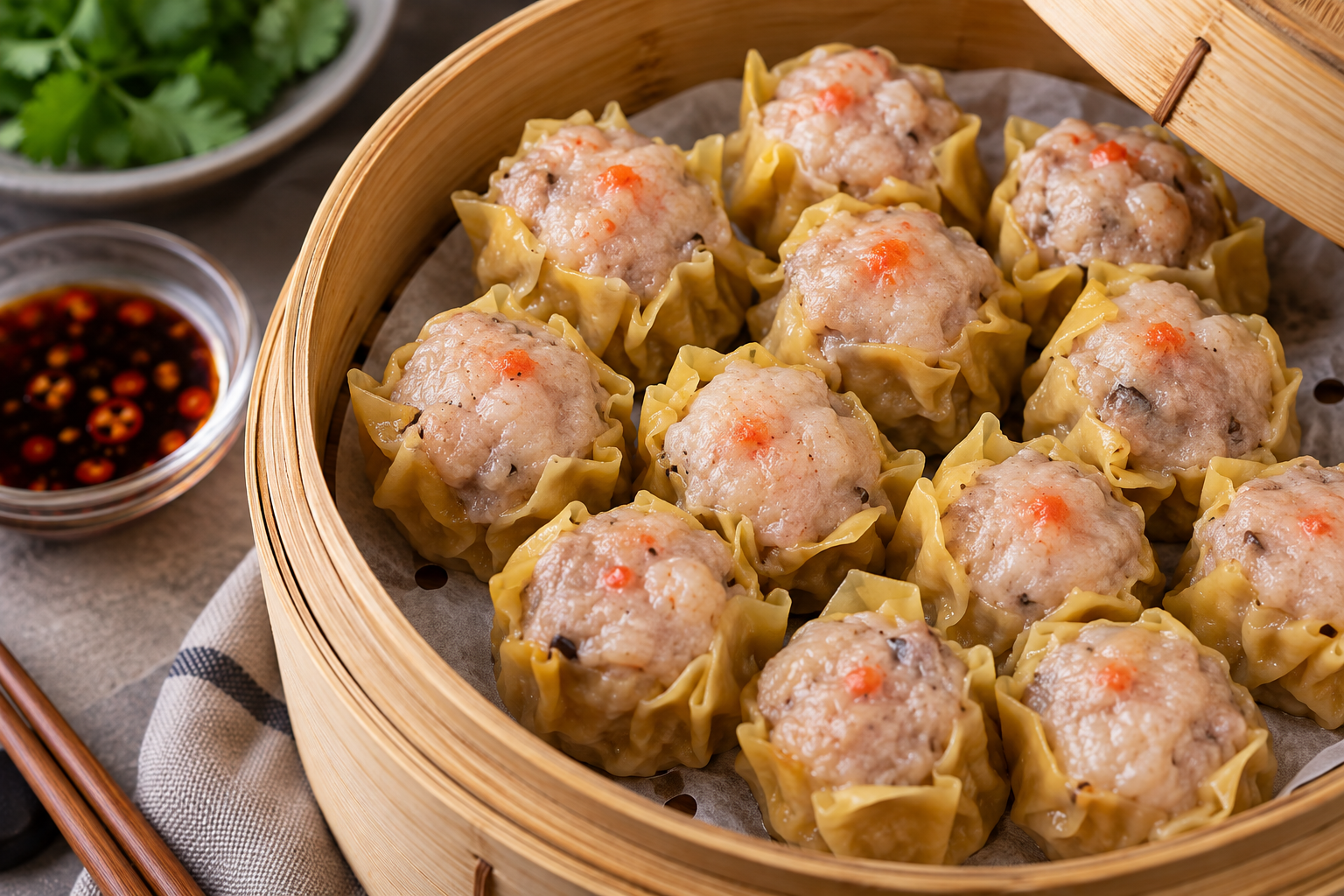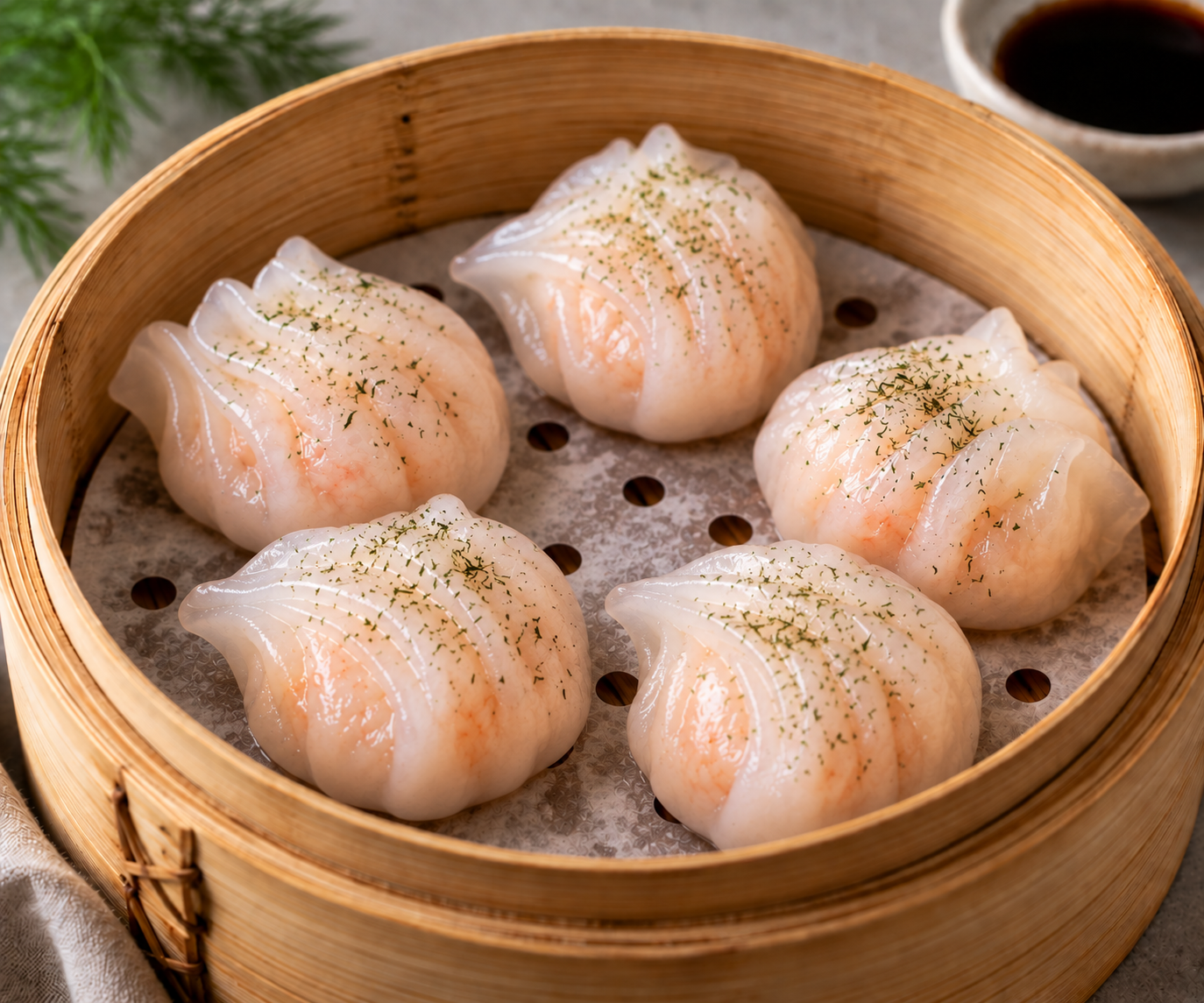
Prawn & Dill Har Gow is another dumpling we know well through POP UP Dumpling Bar.
Despite the name, the dill isn’t actually part of the filling. We use it as a garnish, adding a little colour and freshness to the finished dumpling. Underneath, it’s still all about what makes a good prawn har gow: a translucent, slightly chewy wrapper surrounding a juicy filling with recognisable pieces of prawn.
Like our Pork & Prawn Siu Mai, I’m not putting our commercial production formula online.
Instead, this is my home version. The aim is to recreate the things I like about the dumplings we serve professionally using ingredients and techniques that make sense in a home kitchen.
The filling is deliberately simple. Some of the prawns are chopped more finely to bind everything together, while the rest are kept in larger pieces so there’s no mistaking what you’re eating.
The wrapper takes a little more work than siu mai, but once you’ve made a few, the process becomes surprisingly quick.
And if making har gow wrappers from scratch sounds like more commitment than you had planned, you can always come and eat ours at a POP UP Dumpling Bar pop-up instead.
Prawn & Dill Gow
Ingredients
- Prawn Filling
- 500 g raw prawns peeled and deveined
- 20 g bamboo shoots very finely diced
- 15 g potato starch
- 1 large egg white
- 6 g fine salt
- 5 g sugar
- ½ tsp ground white pepper
- 1 tsp sesame oil
- Har Gow Wrappers
- 150 g wheat starch
- 50 g tapioca starch
- ¼ tsp fine salt
- 220 ml boiling water approximately
- 2 tsp neutral oil
- Garnish
- Fresh dill finely chopped
Equipment
- Large mixing bowl
- Small mixing bowl
- Kitchen scales
- Sharp knife
- Cutting board
- Rolling pin or small dumpling rolling pin
- Dough scraper, optional
- Bamboo or metal steamer
- Steamer liner or perforated baking paper
- Large pot or wok suitable for the steamer
Method
- Prepare the prawns
- Pat the prawns thoroughly dry.
- Divide them approximately 60:40.
- Finely chop the smaller portion until it becomes coarse and sticky, but don’t process it into a completely smooth paste.
- Cut the remaining prawns into approximately 8–10 mm pieces.
- This combination gives the filling enough cohesion to hold together while retaining plenty of recognisable pieces of prawn.
- Start the filling
- Place the finely chopped prawns into a mixing bowl.
- Add the salt, sugar and white pepper.
- Mix vigorously in one direction for approximately 1–2 minutes, until the prawn mixture becomes noticeably sticky.
- Add the starch and egg
- Add the potato starch and egg white.
- Continue mixing until completely incorporated.
- The mixture should become cohesive without becoming wet or runny.
- Add the remaining filling
- Add the diced bamboo shoots and sesame oil.
- Mix briefly.
- Finally, fold through the larger pieces of prawn.
- Don’t aggressively mix once these larger pieces have been added.
- You want them to remain intact in the finished dumpling.
- Chill
- Cover the filling and refrigerate for approximately 20–30 minutes while you prepare the wrappers.
- Make the wrapper dough
- Place the wheat starch, tapioca starch and salt into a heatproof mixing bowl.
- Mix together.
- Bring the water to a full boil.
- Gradually pour approximately 200 ml boiling water over the starch while stirring continuously.
- The water needs to be genuinely boiling. Hot tap water isn’t sufficient.
- Continue adding small amounts of the remaining water as needed until a rough dough forms.
- You may not need the entire 220 ml.
- Knead the dough
- Once the dough is cool enough to handle but still very warm, add the neutral oil.
- Knead for approximately 2–3 minutes until smooth and pliable.
- The dough should be soft but not sticky.
- If it’s dry and cracking, knead in a very small amount of boiling water.
- If it’s excessively sticky, dust lightly with wheat starch.
- Keep the dough covered
- This dough dries considerably faster than ordinary wheat-flour dumpling dough.
- Keep it covered with a damp tea towel or inside a sealed container whenever you’re not actively working with it.
- This includes the individual portions waiting to be rolled.
- Divide the dough
- Roll the dough into a log and divide into approximately 30 equal pieces.
- Keep all but the piece you’re working with covered.
- Roll each portion into a ball.
- Roll the wrapper
- Lightly grease your work surface or dust it very sparingly with wheat starch.
- Flatten one ball.
- Roll it into a thin circle approximately 8–9 cm across.
- Try to make the outer edge slightly thinner than the centre.
- Har gow wrappers should be thin enough to become translucent when steamed, but not so thin that the prawn filling tears through them.
- Fill the har gow
- Place approximately 18–20 g filling into the centre of the wrapper.
- Don’t overfill it.
- Unlike a wheat-flour dumpling wrapper, har gow dough doesn’t stretch particularly well. Trying to force too much filling inside is one of the easiest ways to split it.
- Pleat
- Bring the wrapper around the filling and make several small overlapping pleats along one side.
- Press the pleated edge against the opposite edge to seal.
- Don’t worry if your first few aren’t particularly beautiful.
- Har gow pleating takes practice, and slightly ugly har gow still taste like har gow.
- Repeat
- Continue rolling, filling and pleating one wrapper at a time.
- Keep both the unused dough and finished dumplings covered so they don’t dry out.
- Prepare the steamer
- Bring the steaming water to a strong boil.
- Line the steamer with perforated baking paper or another suitable steamer liner.
- Arrange the har gow with enough space between them that they aren’t touching.
- Steam
- Place the dumplings into the already-hot steamer.
- Steam for approximately 6–8 minutes, until the wrappers become translucent and the prawn filling is completely cooked.
- The exact time will depend on the size of your dumplings and steamer.
- Rest briefly
- Remove the steamer from the heat and leave the har gow for approximately 1 minute before trying to move them.
- The wrappers are particularly delicate immediately after steaming and become slightly easier to handle after a short rest.
- Garnish with dill
- Finely chop a small amount of fresh dill and scatter it lightly over the steamed har gow immediately before serving.
- The dill is deliberately only a garnish.
- It isn’t mixed through the prawn filling. You should still taste this primarily as prawn har gow, with just a little fresh dill at the finish.
- Serve immediately.
Private Notes
Tried this recipe?
Let us know how it was!Why Use Two Prawn Textures?
If all the prawns are minced very finely, the filling can become too uniform.
If they’re all left chunky, the filling doesn’t bind together as nicely.
Using some finely chopped prawn creates the sticky base that holds the filling together, while larger pieces provide the texture I actually want when biting into har gow.
Why Wheat Starch?
Despite its name, wheat starch isn’t the same thing as ordinary wheat flour.
It’s responsible for much of the characteristic translucent appearance and slightly chewy texture of har gow wrappers.
Tapioca starch adds elasticity, which makes the dough somewhat easier to work with and contributes to the finished texture.
I wouldn’t substitute ordinary plain flour and expect the same result.
The Water Needs to Be Boiling
This is one of the important parts of making har gow wrappers.
The starch needs very hot water to gelatinise properly.
I therefore boil the water and use it immediately rather than allowing it to sit in the kettle while preparing everything else.
Don’t Make All 30 Wrappers First
With ordinary dumpling dough, you can sometimes roll a stack of wrappers before filling them.
I wouldn’t do that here.
Har gow dough dries quickly and becomes increasingly prone to cracking.
My preferred workflow is:
Portion → roll one wrapper → fill → pleat → cover → repeat.
It’s slower initially, but you’ll waste fewer wrappers.
About the Dill
The dill in Prawn & Dill Har Gow is a garnish, not the defining flavour of the filling.
That’s intentional.
Prawn is delicate, and putting a substantial amount of dill directly into the filling would completely change the character of the dumpling.
A small amount over the finished har gow gives you the aroma and freshness without masking the prawn.
A Note About This Recipe
At POP UP Dumpling Bar, we make our Prawn & Dill Har Gow professionally in our contracted commercial kitchen.
This isn’t that commercial recipe.
This is my home interpretation, designed around the characteristics I want from the har gow we serve: plenty of prawn, noticeable pieces rather than a completely processed filling, a soft translucent wrapper and a little fresh dill over the finished dumplings.
It’s a way of sharing what we’ve learned from making dumplings professionally without giving away everything we do behind the scenes.
Too Much Effort?
I’ll admit that making har gow wrappers from scratch isn’t the quickest route to eating dumplings.
But that’s also part of what makes them satisfying to make.
If you get through the first few wrappers and decide you’ve gained enough appreciation for the process without needing to make another 25, there’s another option.
Come and find us at POP UP Dumpling Bar and we’ll make them for you.
Find our next pop-up →
Or if you’d rather have the dumplings come to you:
Catering with POP UP Dumpling Bar →